
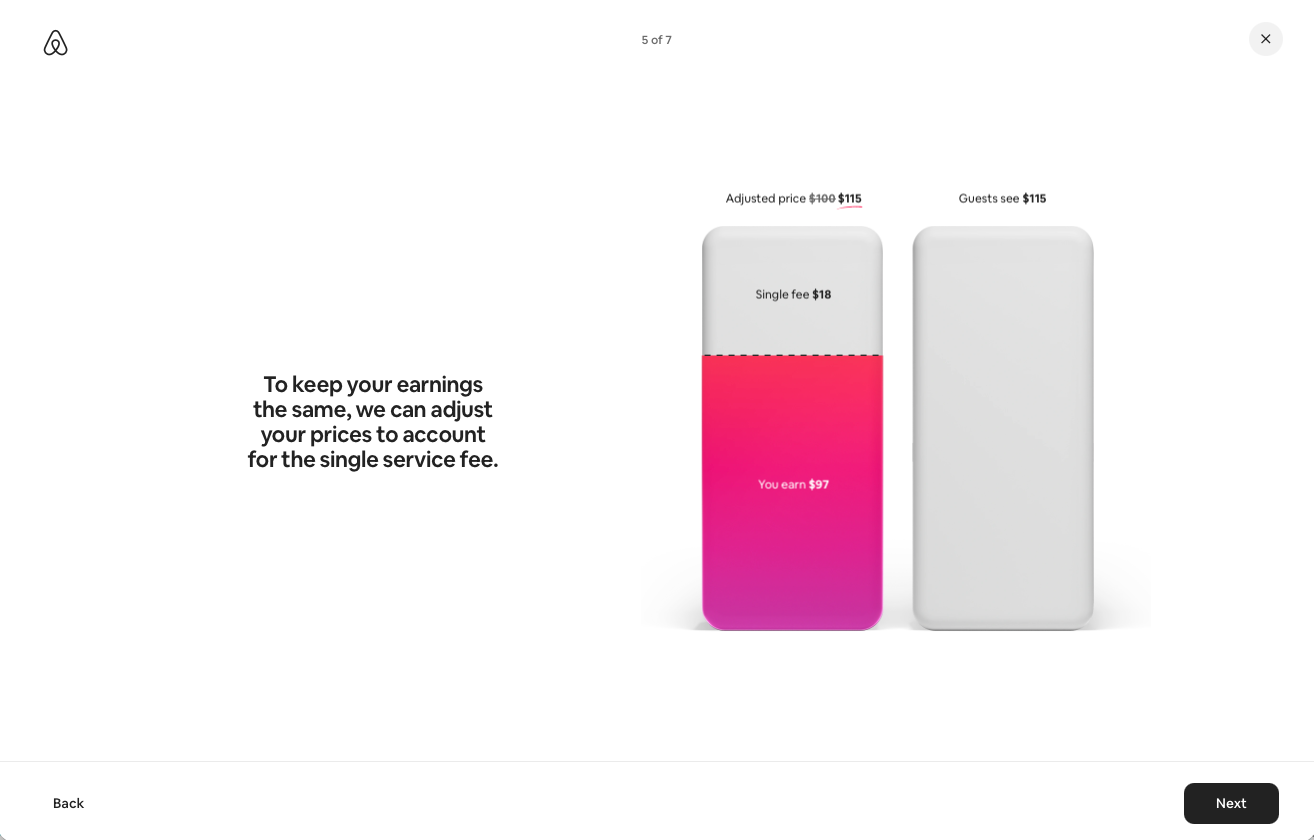
Airbnb’s fee-shift message is easy to understand at first glance. The host sets a $100 price, the guest used to see about $115 after the guest service fee, and the host used to earn about $97 after the old host service fee. Then Airbnb shows the new version: raise the displayed price to $115, deduct the new single service fee, and the host still earns $97.
The message is powerful because it gives a normal host permission to stop thinking. Nobody wants to rebuild every future night while Airbnb changes the fee structure underneath the calendar. If the platform says it can adjust prices so earnings stay the same, the tempting move is to accept the adjustment and move on.
Real listings are not one clean $100 slide. A real listing may have cleaning fees, pet fees, extra guest fees, weekly discounts, custom weekend rates, Smart Pricing limits, tax behavior, and payout previews tied to the stay pattern. My concern is not the existence of a fee change; my concern is the gap between a simple earnings-preservation message and the messier payout review a host still has to do.
The Slide Makes It Look Simple
The featured Airbnb slide says Airbnb can adjust prices to account for the single service fee so host earnings stay the same. The visual example moves the adjusted price from $100 to $115, shows guests seeing $115, deducts an $18 single fee, and leaves the host earning $97. A host looking at the slide can reasonably walk away with a simple takeaway: Airbnb can solve the earnings problem through a price adjustment.
The example has value. It explains the basic difference between the old split-fee model and the newer single-fee model in a way most hosts can follow. Under the old example, the guest service fee sat on top of the host’s listed price, while a smaller host fee came out of the host payout.
Under the new example, more of the fee appears on the host side. The guest can see a clearer displayed price, but the host has to set a higher gross price if the goal is to preserve the old payout. Airbnb communicates this basic mechanism clearly enough in the slide.
The concern is what the slide leaves out. It does not walk the host through a real listing with add-on fees, discounts, custom rates, taxes, or Smart Pricing. It makes the change feel like a clean swap, while the host still has to check the actual listing math.
What Changed In The Airbnb Service-Fee Model
Airbnb’s service-fee help page describes two fee structures for stays: split fee and single fee. In the split-fee structure, the fee is divided between host and guest, and Airbnb says most hosts pay a host service fee around 3 percent, with guest service fees often falling in a range based on the booking subtotal. In the single-fee structure, Airbnb deducts the whole service fee from the host payout, and the current Airbnb help page says most hosts pay 15.5 percent, with stated variation and exceptions.
For a host, the key shift is not just who gets labeled as paying the fee. The host’s listed price has to carry more of the service-fee load if the host wants the same payout after the booking is confirmed. The new displayed price can look higher even when the host is not trying to raise profit.
Airbnb’s April 10 PMS and channel-manager Resource Center page shows the single-fee shift first landing in a software-connected context, but Airbnb’s public materials also speak to home hosts who do not use property management software. The price adjustment tool page says Airbnb built a tool for those hosts as they move from split fee to single fee. This is not only a large-manager or channel-manager issue for small hosts who receive the notice in their own account.
The safe takeaway is narrow. Hosts should not assume every host everywhere is moving at the same time or under the same rules. Treat general examples as prompts for review, then check your own Airbnb notice, fee structure, and payout previews.
Why The $100-To-$115 Example Is Not Enough
Airbnb’s newer Resource Center page, “Simplifying service fees on Airbnb,” gives the clean example hosts are likely to remember. It explains a $100 price, a guest seeing $115, a host earning $97, and a later $115 price leaving the host with $97 after the single service fee. It also says the examples do not account for fees hosts choose to add or taxes.
The footnote is important, but a host does not operate a footnote. A host operates a calendar, and the calendar is where cleaning fees, custom prices, discounts, taxes, and payout previews show up. If the main message says the adjustment can keep payouts per night the same, the fee-base mechanics need to be just as plain as the promise.
Airbnb’s own price adjustment tool page gives Airbnb a meaningful limiting point. It says the tool can adjust current prices inclusive of additional fees like cleaning fees, extra guest fees, and other host-set fees, and it says confirmed adjustments update current prices and additional fees for a two-year calendar window. A fair critique should not claim the tool adjusts only nightly rates.
The issue is the host-facing explanation. Even if the tool can adjust additional fees, the message can still be too simple for the decision being made. A host with add-on fees, Smart Pricing, and discounts needs to know what changed, what did not change, and what still needs manual review.
The Trap In The Percentage
One common host mistake is treating 15.5 percent like the exact amount to add to an old nightly rate. The payout math works differently because the fee is deducted from the new higher gross price. The fee comes off the adjusted price, so a host trying to preserve a prior net payout has to think in retained share.
Retained share after a 15.5% host-side fee = 84.5%
Required gross price = current net payout / 0.845
$97 / 0.845 = $114.79
A 15.5 percent host-side fee can imply roughly an 18.34 percent gross-up before rounding in a simple example. The number is not a rule for every listing, and it is not a demand-based price increase. It is only a way to understand why “15.5 percent fee” and “15.5 percent price increase” are not the same thing.
Hosts often read a higher calendar price as a pricing decision. In this case, the first move may not be a pricing opinion at all. It may simply be the platform math required to keep the same old payout after the service-fee structure changes.
The Legal Lens, In Plain English
The legal issue is easier to understand without opening with legal vocabulary. A platform message can be technically narrow and still create a broader takeaway in the reader’s mind. If the takeaway is “your earnings can stay the same,” payout details become important.
This is the plain-English version of a deception-style concern. Section 5 of the FTC Act prohibits unfair or deceptive acts or practices in commerce, and the FTC’s Policy Statement on Deception looks at whether a representation, omission, or practice is likely to mislead a reasonable audience in a material way. For hosts, “material” is not abstract; payout math affects whether a host accepts the tool, changes rates, or reviews the calendar manually.
I am not saying Airbnb violated the FTC Act. My point is narrower and more practical. Airbnb’s host-facing earnings-preservation message deserves scrutiny because the simple version can leave a host with an incomplete impression of the real payout mechanics.
The FTC fee rule adds useful context, but it should not be overstated. 16 C.F.R. Part 464 addresses unfair or deceptive fees for covered goods and services, including short-term lodging, and the FTC’s fee-rule FAQ discusses vacation rentals, cleaning fees, business consumers, and online marketplaces. The background reinforces why clear lodging-fee information is important for hosts, but it does not make every host-facing tool screen a Rule 464 violation.
Separate Fee Math From Pricing Judgment
For STR Signals, the operator move is simple: treat the fee shift as a baseline reset before treating it as market feedback. A higher displayed rate after a platform fee change is not proof demand improved. A lower payout after rejecting an adjustment is not proof your listing suddenly became weaker.
Small hosts need a clean paper trail. Save the Airbnb notice, record the date of the change, write down the old fee structure, write down the new fee assumption, and note whether the change applied to nightly rates, cleaning fees, pet fees, extra guest fees, Smart Pricing limits, or discounts. The Airbnb rate change log exists for exactly this kind of baseline note.
The documentation protects future KPI reads. If September bookings look different from August bookings, some of the change may be market demand, but some may be the new fee display, a different guest-facing price, or a different retained payout. Read performance against available nights, not calendar nights, and do not compare old and new periods as if the pricing base stayed identical.
A Smart Pricing sanity check belongs in the same review. If Smart Pricing minimums and maximums moved as part of the adjustment, a host may think Airbnb is reading demand when it is really protecting a new fee baseline. Keep platform math and demand judgment in separate columns.
What Small Hosts Should Check Before Accepting The Adjustment
Before accepting a one-time adjustment, start with the next set of future unbooked Airbnb nights. Booked reservations may be unaffected, and Airbnb’s tool page says changes apply to reservations made after the adjustment is complete. This is a forward-pricing issue, not a reason to rewrite historical revenue or already-booked nights.
Then check the components of the listing, not just the headline nightly rate. Look at cleaning fees, pet fees, extra guest fees, custom rates, discounts, and Smart Pricing minimums and maximums. Airbnb says its tool can adjust additional fees, but the host should still verify the preview instead of assuming every component landed cleanly.
Next, test representative dates before and after the change. Use payout previews where Airbnb provides them, and compare the guest-facing total, host payout, and fee line under realistic stay patterns. A one-night weekday, a two-night weekend, and a longer discounted stay can tell a host more than one clean example.
Finally, decide what is platform math and what is actual pricing strategy. If the adjustment exists only to keep the old payout neutral, label it as platform math in your notes. For a broader operating workflow, use the Airbnb tools and templates for normal hosts and pair the change with a simple first Airbnb KPI sheet so future reads do not blur together.
What Not To Do With The New Numbers
Do not treat the new gross price as proof your market supports a higher rate. If the price rose because the fee structure changed, the calendar is carrying a different fee presentation, not necessarily a stronger demand signal. This is a platform math reset before it is a pricing conclusion.
Do not apply one percentage blindly to every line item without checking the actual Airbnb tool behavior in your account. The payout illustration above explains why roughly 18.34 percent can preserve a $97 payout under a clean 15.5 percent assumption, but your listing may have taxes, additional host-set fees, discounts, country exceptions, or different booking behavior. The right move is to verify the payout preview, not memorize a single markup.
Do not rewrite your historical KPI. Old booked revenue, old canceled reservations, old manual blocks, and old calendar gaps should stay in their original context. If a platform event creates a new pricing decision, mark the event and measure forward from the new baseline.
Do not turn the fee shift into panic pricing. A soft booking week after the change might reflect guest reaction to displayed totals, a seasonal pattern, competitor moves, or ordinary calendar noise. Start with the STR Signals host framework and keep the question practical: what changed in the platform math, what changed in guest demand, and what can the host actually verify?
Bottom Line For Small Hosts
Airbnb’s simple slide is useful, but it is not a full listing audit. It explains how the single-fee shift can preserve a clean example payout if the adjusted price rises from $100 to $115. It does not replace a host’s own review of fees, taxes, discounts, Smart Pricing behavior, and payout previews.
The legal concern is not Airbnb’s ability to change its fee model. The concern is a strong earnings-preservation message without equally clear details about what the adjustment covers, what it does not cover, and why actual bookings, earnings, and payouts may vary. I read this as a deception-style policy concern, not a final legal verdict.
For a normal host, the practical answer is to slow the decision down. Save the notice, check the fee base, preview real dates, record the baseline reset, and then watch future performance against available nights. For more STR Signals context, keep the STR Signals article library nearby and treat the fee shift as one more platform event needing clean notes before it becomes a pricing story.
Disclaimer
Opinion and practical host analysis only, not legal advice. Hosts should review their own listing, payout previews, and account notices before making pricing decisions. Platform rules, fee notices, and tax treatment can vary by account, market, and booking pattern.
About The Author
Waymond Wesley II writes STR Signals from the combined perspective of legal-analysis work and hands-on short-term rental operation. His work focuses on practical host decisions, clean KPI baselines, and platform-policy changes normal hosts can verify. The goal is to help small operators separate platform mechanics from pricing judgment without turning every dashboard change into drama.
Host questions this article answers
Check lead time, booking pace, day type, gap shape, and revenue context before choosing the pricing move.
No. It may be early in the booking window, blocked by shape, or isolated to weak day types.
Tools can suggest numbers. The decision still needs context from the host calendar and KPI history.